
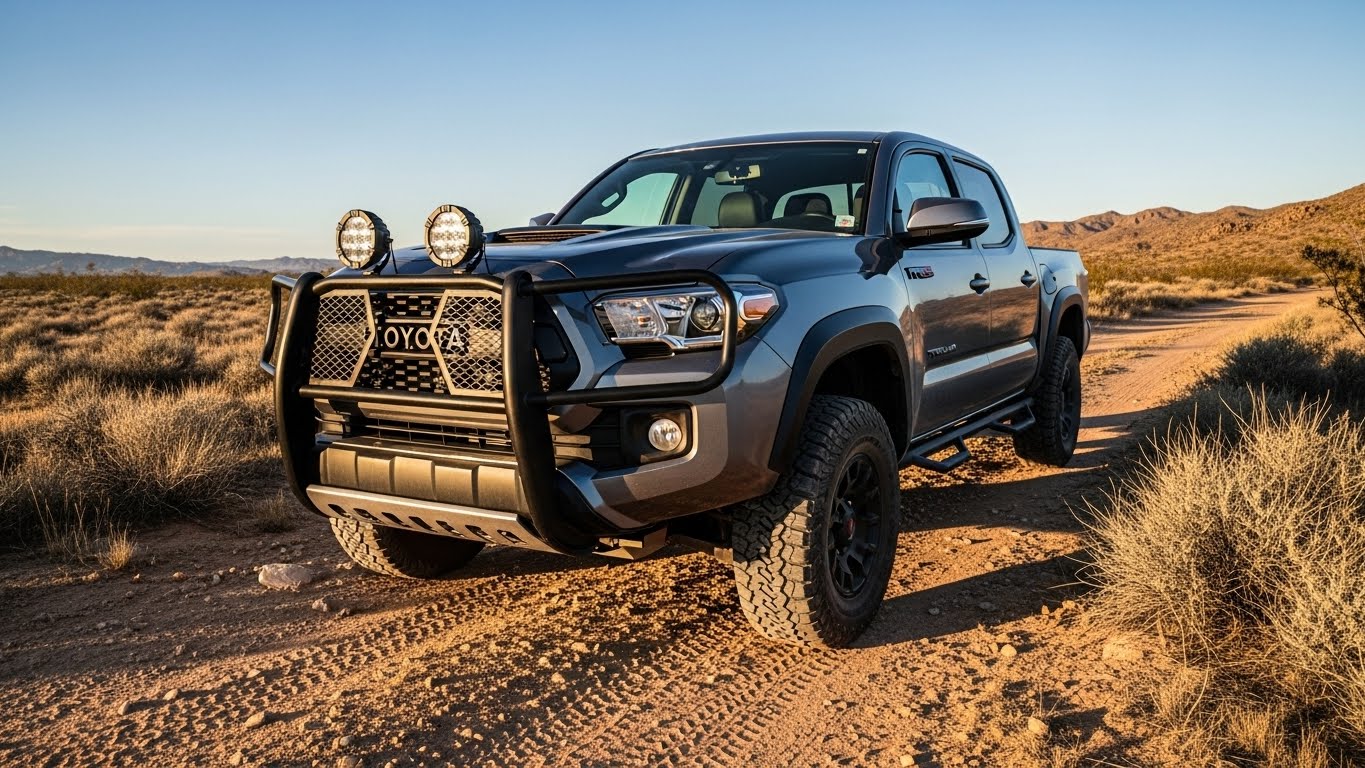
A grille guard (often called a brush guard, bull bar, or push bar) usually isn’t automatically illegal across the United States. But it can become illegal (or get you ticketed / fail inspection) depending on how it’s designed, what it blocks, who installs it, and where you drive (state + sometimes city rules).
What makes this confusing is that US law splits the world into two lanes:
- Federal rules (mainly about new vehicles, certified equipment, and commercial installers/repair businesses)
- State/local rules (what’s allowed to operate on public roads in that state/city)
Below is the practical, US-only breakdown.
The key federal issue: headlights can’t have a “guard” in front of the lens (on new/sold vehicles)
At the federal level, FMVSS 108 (the lighting standard) is where grille guards most commonly collide with legality.
NHTSA has repeatedly interpreted FMVSS 108 to mean that you cannot have a brush-guard/lamp-guard sitting “in front of the headlamp lens”—that configuration is treated as prohibited. In one interpretation, NHTSA is very direct that front brush guards in front of headlamp lenses are prohibited (referring to the FMVSS 108 provision). NHTSA
Why this matters
- Vehicle manufacturers must certify new vehicles comply with FMVSS. If a new vehicle is equipped with a guard in front of the headlamp lens, the manufacturer generally couldn’t certify compliance.
- NHTSA has also stated that a vehicle (example: Range Rover) could not be displayed for sale and sold with a brush bar installed if the lamp-guard portion is in front of the lens (unless those lamp guards are removed). NHTSA
This is a big reason you’ll see many “grille guards” designed to wrap around the grille/bumper area but avoid sitting directly in front of the headlamp lens.
2) “Make inoperative” rules: installers and repair businesses have legal exposure
Even if you can bolt something onto your own truck, a dealer, installer, or repair shop has to worry about the federal “make inoperative” rule.
Federal law (49 U.S.C. § 30122) says a manufacturer, distributor, dealer, rental company, or motor vehicle repair business may not knowingly make inoperative a safety device or design element installed to comply with a federal safety standard. Legal Information Institute
There are specific exemptions in regulations (49 CFR Part 595), but the default rule is “don’t disable compliant safety systems.” eCFR
Why modern vehicles raise the stakes
If a grille guard interferes with equipment that’s part of compliance (classic example: required lighting), that’s a problem. And as more safety systems become federally regulated, the “don’t make it inoperative” principle becomes more relevant. NHTSA has explicitly discussed 30122 in the context of required safety systems. Federal Register
3) State law is where most “is it illegal?” questions get decided
For regular drivers, the most common state-level reasons a grille guard becomes “illegal” in practice are:
A) It blocks required lights or the light beam
Many state inspection rules and equipment laws don’t say “grille guards are banned,” but they do say you can’t obstruct lamps or their beam.
Example (Pennsylvania inspection regulations): a vehicle shall not have auxiliary equipment so placed as to obstruct beam, and inspection rules can reject vehicles where auxiliary equipment is placed on, in, or in front of a lamp. Pennsylvania Government
So even if your guard is “mostly fine,” if it shades a headlamp, fog lamp, or turn signal, that’s where you get nailed.
B) It blocks your license plate (especially front plates)
A grille guard often sits exactly where a front plate bracket goes, so plate visibility becomes a frequent issue.
Examples:
- California requires plates be securely fastened, clearly visible, and clearly legible. Justia Law
- Texas prohibits plates with coatings/coverings/materials that distort visibility or obscure the plate, and also bans certain devices/attachments that interfere with readability. Texas Statutes
If your guard forces a plate relocation, you want a mount that keeps it unobstructed and in the state’s required position.
C) It creates an unsafe protrusion or hazard
Even where grille guards are common, states can still cite you if the setup is considered unsafe (sharp edges, torn metal, unsafe mounting, etc.).
Example:
- California broadly prohibits operating a vehicle in an unsafe condition that presents an immediate safety hazard.
- Pennsylvania inspection rules can reject a vehicle if a broken/torn portion is protruding so as to create a hazard, and also for protruding metal/glass/parts that create a hazard. Pennsylvania Government
D) It fails a periodic safety inspection
Not all states have safety inspections, but where they do, a grille guard can fail you for:
- lamp obstruction,
- unsafe protrusions,
- bumper-related issues (depending on how the guard integrates).
Pennsylvania’s published inspection regulations show examples of bumper-related rejection criteria (including hazard/protrusion and “extends beyond body line” type concepts).
4) City/industry rules: sometimes they’re banned for specific vehicle types
Even if your state allows grille guards generally, a city regulator or fleet rule might ban them for certain vehicles.
Example: the NYC Taxi & Limousine Commission issued a notice that no push bars, grill guards, or bumper guards are permitted on NYC taxis (focused on pedestrian injury reduction). NYC.gov+1
So if you’re asking for a taxi, livery, security fleet, or certain commercial use case, you have to check the specific regulator.
5) So… are grille guards illegal?
In the USA, for most privately owned vehicles:
- A grille guard is often legal in concept
- But it becomes illegal (or functionally “not allowed”) if it:
- sits in front of the headlamp lens (federal lighting compliance issue in NHTSA’s interpretation)
- blocks lamps, reduces the beam, or obscures required lighting (common state inspection issue)
- obstructs the license plate (very common),
- creates dangerous protrusions or an “unsafe vehicle” situation,
- violates city/fleet rules for certain vehicle classes (like taxis). NYC.gov
6) A practical “stay-out-of-trouble” checklist (US)
If you want the short version of how people keep these legal:
No bars/mesh directly in front of the headlamp lens (don’t buy a design that “guards” the headlight face). NHTSA
- Stand in front of the vehicle at night:
- confirm the guard doesn’t cut off or shadow the beam pattern
- Keep the license plate fully visible (front plate if required in your state), and avoid any setup that obscures numbers/letters. Justia Law
- Avoid sharp edges and ensure it’s firmly mounted (no “hazard” protrusions). Pennsylvania Government
- If you’re having a shop install it, choose one that takes “make inoperative” risk seriously (especially around lighting and safety systems). Legal Information Institute+1
- If you drive commercially (taxi/for-hire/fleet), check your regulator first. NYC.gov
If you tell me your state (and whether the vehicle is private or commercial), I can point out the most common grille-guard tripwires for that exact situation.
